Licensed Termite Inspections in Southern California
Expert termite inspections to detect and prevent costly damage to your home.

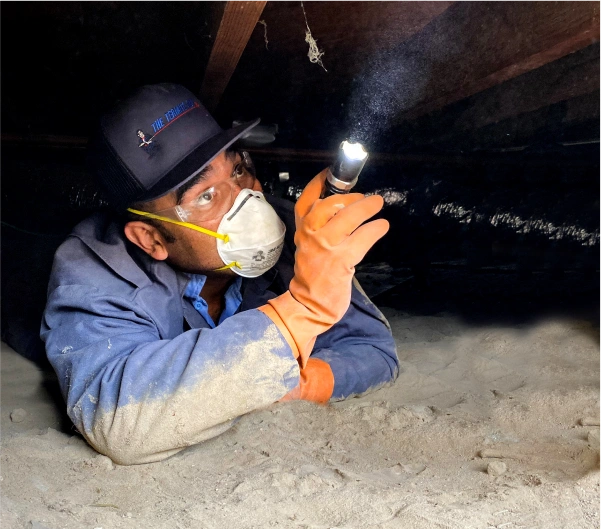


Get peace of mind with thorough termite inspections from our licensed experts. We provide detailed evaluations using advanced technology for accurate assessments.






Serving Southern California Since 1997


Briant Patterson
Commercial Services
Scott Bingham
Commercial Services
Zaf Niazi
Commercial Services
Deeann Graham
Commercial Services
Jonathan Skorheim
Commercial Services
Randy Rimmey
Commercial Services
Ryan Ole Hass
Commercial Services
Sara Pirooz
Home Repair
Justin Paxton
Fumigation
Bart Williamson
Treatment & Repair
Bonnie Frisch
Home Repair
Marc Guirguis
Home Repair
Larry Perez
Fumigation
Kevin Mendoza
Home Repair
Rene Schlegel
Pest Control
Donna Yslas
Treatment & Repair
Carol Saunders
Commercial Services
Ruby Vazquez-Urzua
Termite Treatment
Connor Limburg
Treatment & Repair
Ricky Mar
Treatment & Repair
Christopher Ruzin
Termite Treatment
Patricia Davis
Termite Treatment


Our technician will call or text ahead, walk the property with you if you're home, and explain findings and next steps in plain language before leaving you with a written report. There's no pressure to decide on treatment on the spot — you'll have the information you need to make the right call for your home.
Warranties typically exclude new damage caused by structural changes made after treatment, conditions an inspector couldn't access, and situations where required follow-up inspections were skipped. Specific terms are spelled out in writing with every warranty we issue.
Yes. Our warranties stay with the property, not the homeowner, so they can be transferred to the new owner when the home is sold. A transferable termite warranty can be a valuable selling point, giving buyers added confidence that the home remains protected.
Our fumigation treatments come with a 5-year warranty against drywood termites, so if the same type of infestation returns to the treated structure within that period, we'll address it under the warranty terms provided in writing at the time of treatment.
Call our office to discuss available payment options for your specific service.
Yes — ask about a free estimate when you schedule with us.
Reach out to our team to complete our RFP form and provide a site map and we can provide a proposal for the property.
That depends on the association's governing documents and how common areas versus units are defined, which varies by HOA. We provide the inspection findings and cost information; the board determines how responsibility is allocated under their CC&Rs.
Yes — we provide written inspection reports and treatment documentation that can be kept on file for HOA board records, reserve studies, or insurance requirements.
We can provide both. Some multi-unit properties prefer to have us on an as needed basis. Other property management clients are on a recurring inspection program, typically annually, so termite activity is caught early across the entire property rather than discovered unit-by-unit after damage has already occurred.
We work directly with property managers or HOA boards to build an inspection and treatment calendar that minimizes disruption to residents, often phasing work building-by-building or floor-by-floor.
Yes — we coordinate inspection schedules across multiple units and common areas, which is typically far more efficient and cost-effective than scheduling each unit separately.
Yes — we provide termite inspections, pest inspections and treatment programs tailored specifically for each multi-unit property across Southern California.
Generally, no. Most homeowners insurance policies treat termite damage as a maintenance issue rather than a covered peril, since infestations develop gradually rather than from a sudden event.
Once termite damage is identified as a Section 1 item on the inspection report, it often becomes part of the negotiations between the buyer and seller. Whether the repairs are completed before closing or handled another way depends on the terms of the purchase agreement. We can handle the entire process, from the initial termite inspection to the repair estimate and in-house wood repairs, providing a seamless experience from start to finish.
Yes. We regularly inspect properties for purchase transactions and refinances, and we provide reports formatted for lenders and escrow exactly the way they require, with fast turnaround during time-sensitive closings.
Yes. Buyers are entitled to order their own inspection from any licensed company, and many do, particularly if the seller's report seems incomplete or if they want a second opinion before closing.
Yes, ordering your own inspection before listing lets you address any findings on your own timeline, choose your own termite control company, and avoid last-minute surprises from a buyer's inspector that could delay or derail the sale. A clean report can also reassure buyers, especially in a competitive market.
A California structural pest control report is generally valid for 90 days from the inspection date. If escrow doesn't close within that window, most lenders will require a new inspection.
A clearance is written confirmation, issued after Section 1 work is completed, that a property is free of active termite infestation. Lenders and escrow companies require this confirmation before funding a loan tied to a termite contingency.
California law doesn't require either party to pay; it's negotiated as part of the purchase agreement. In practice, sellers often address Section 1 items to keep the sale moving, while Section 2 items are more commonly negotiated as credits or left for the buyer.
Section 2 covers conditions that could lead to infestation in the future but aren't active problems yet — things like wood-to-soil contact, faulty grade, excess moisture or leaking plumbing. Section 2 items are negotiable between buyer and seller and aren't required to close escrow. Some strict loan types (like VA or FHA) may require certain Section 2 items to be corrected before closing.
Section 1 covers evidence of active infestation or existing damage from wood-destroying organisms — live termites, active mud tubes, or wood already damaged by termites, fungus, or other wood-destroying pests. These items typically must be resolved before a real estate transaction can close.
In nature, termites are valuable decomposers that break down dead wood and recycle nutrients back into the soil. The issue is only when they target a structure instead of a fallen log — which is exactly when it's time to call in a professional.
Homeowners insurance typically does not cover termite damage because it is considered a preventable maintenance issue rather than a sudden or accidental event. Termite inspections and prompt treatment are the best way to detect infestations early, minimize damage, and avoid costly repairs.
They spread through swarmers — winged adults that fly from an existing colony and land directly on exposed wood to start a new colony. They can also be introduced through infested furniture, framing lumber, or firewood brought into the home.
Dampwood termites are drawn to wood with high moisture content, particularly decaying or water-damaged lumber, and unlike subterranean termites, they don't require soil contact to survive. Leaky pipes, poor drainage, and old water damage are the most common causes of dampwood activity in homes.
Yes — drywood termites can survive in wood with much lower moisture content than other termite species, often around 12%, which is part of why they thrive in dry Southern California wood framing, siding, and furniture.
A mature subterranean termite colony can contain anywhere from 60,000 to several million individuals, constantly foraging and feeding underground and through your structure's wood. Drywood termite colonies are smaller, but a single structure can host multiple separate colonies at once.
Mud tubes on foundations or walls, hollow-sounding wood, and discarded wings near ground-level entry points are the most common signs. Because they travel through soil, subterranean termite activity is often hidden behind walls or under flooring until an inspection uncovers it.
Look for small kickout holes surrounded by tiny termite droppings (called frass). These pellets are hard, dry, and about the size of a grain of sand or ground pepper, with a distinctive oval shape and six concave sides. Their color can range from light tan to dark brown or black, depending on the type of wood the termites have been feeding on. Other signs include hollow-sounding wood and discarded wings near windowsills, doors, or light fixtures after a swarm. In Southern California, drywood termite swarmers are most commonly seen in late summer through fall.
A large, established subterranean colony can cause serious structural damage within 2–3 years, though most damage takes longer to become significant. Drywood termite damage tends to develop more slowly, often taking 3–5 years before it's visibly noticeable.
Mud tubes are pencil-width tunnels subterranean termites build to travel between soil and wood while staying protected from predators and dehydration. Finding mud tubes on a foundation, pier, or exterior wall is one of the clearest signs of subterranean termite activity.
Subterranean termites live in the soil and travel into structures through mud tubes, needing constant ground contact for moisture. Drywood termites live entirely inside the wood they infest, need no soil contact, and can survive in wood with much lower moisture content.
The report identifies what was found; from there we'll recommend a treatment approach and provide a cost estimate based on the extent and type of infestation. Localized treatment pricing depends entirely on the inspection findings, and fumigation pricing is based on the cubic footage of your home.
Clear access to your attic hatch, crawl space entry, water heater closet, and any areas where stored items block exterior walls.
The California Structural Pest Control Board recommends having your home professionally inspected every 2 to 3 years. Because termites can establish a colony and remain hidden for years before swarming, regular inspections help detect infestations early, identify conditions that attract termites, and prevent more extensive damage.
Yes. Subterranean termites travel through soil and mud tubes, often staying inside walls or under floors where they're never seen until damage is significant. Drywood termites can be active inside a single wall stud for years before kickout holes or discarded wings ever appear.
Ask about a free estimate when you call to schedule — in most cases there's no cost to you to find out what's going on with your property and get a treatment recommendation.
It helps, but it isn't required as long as our inspector can access the exterior, garage, attic, and crawl space. If interior areas need to be checked, someone with access should be available, or arrangements can be made in advance.
Most residential inspections take 30–60 minutes, depending on the size of the home and how accessible the crawl space, attic, and exterior are. Larger properties or homes with limited access points may take longer.
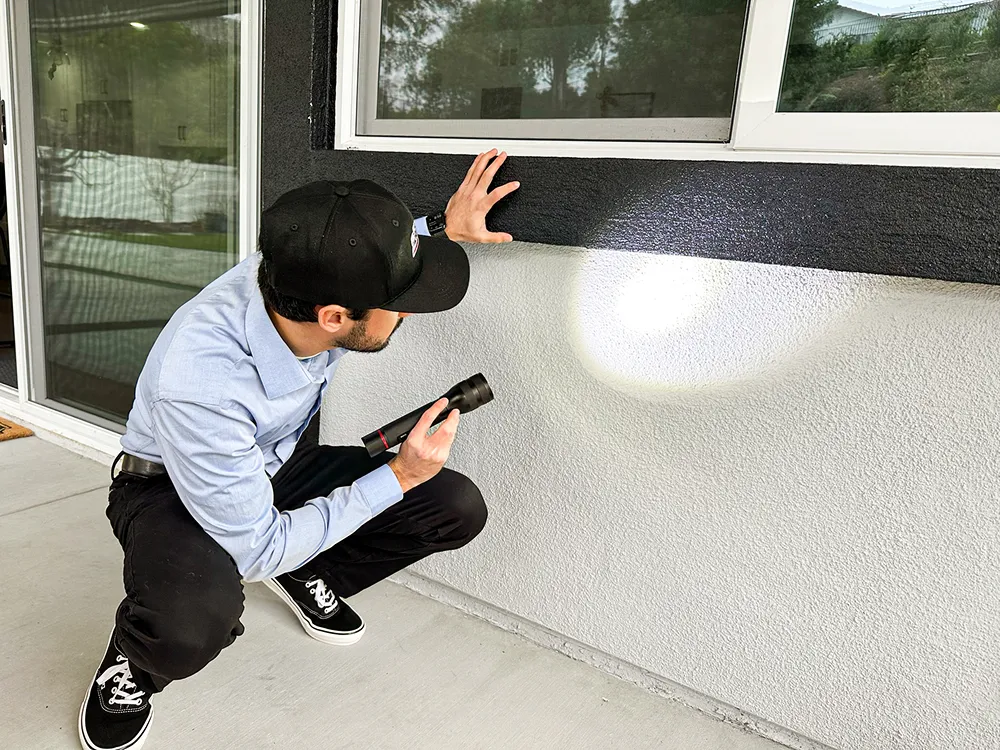
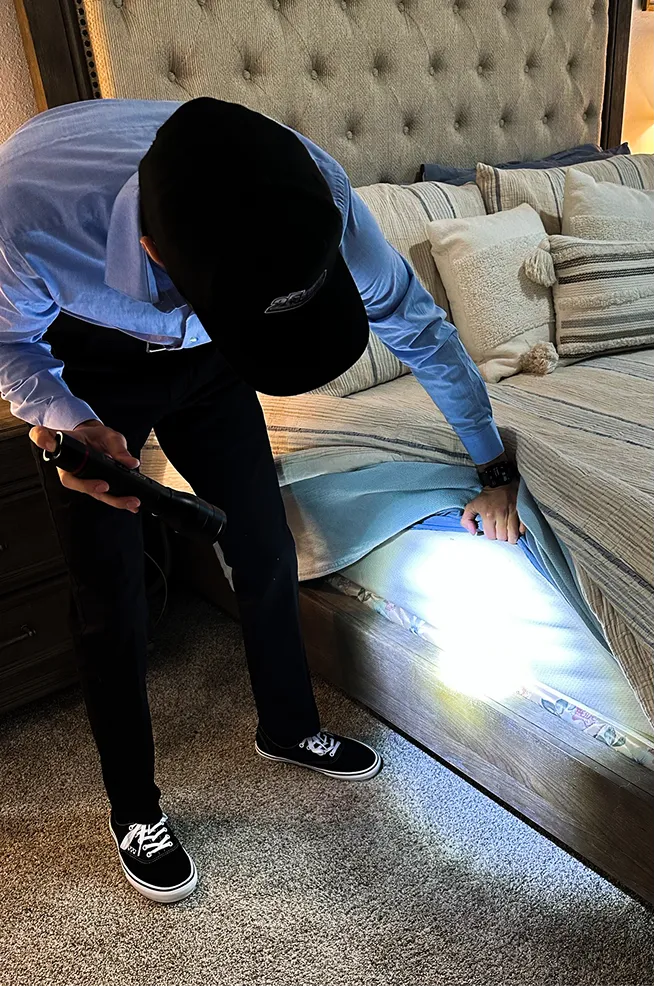
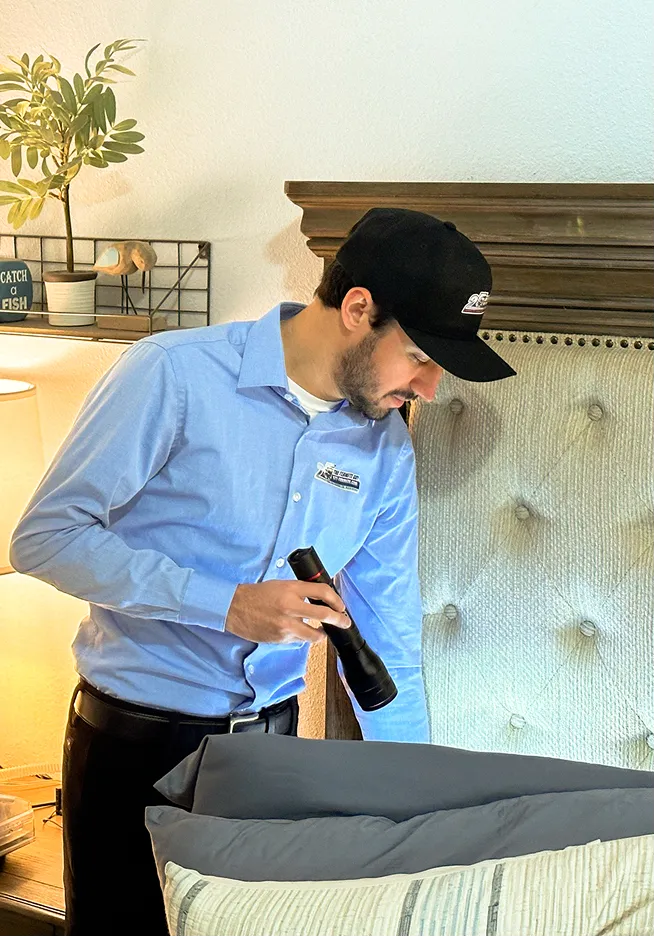
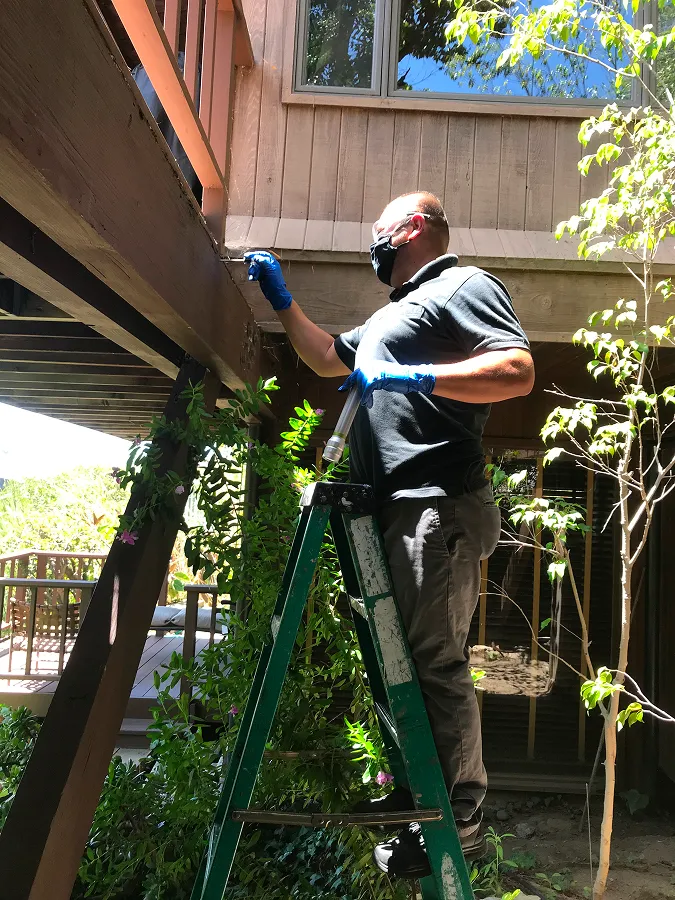
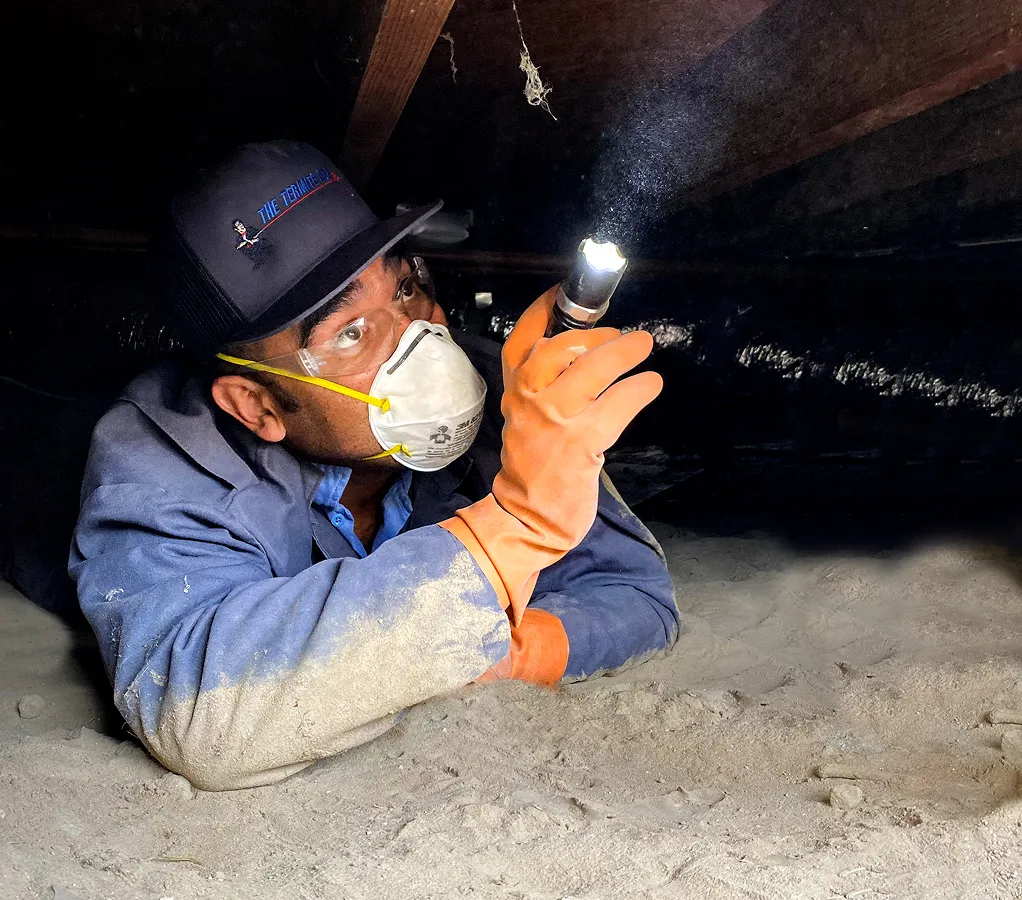
A licensed inspector examines accessible areas of your home — foundation, crawl space, attic, eaves, and any wood-to-soil contact points — for live termites, damage, and the moisture conditions that attract them. You'll receive a written report identifying any findings, organized by California's standard Section 1 (active infestation or damage) and Section 2 (conditions likely to lead to infestation) categories.
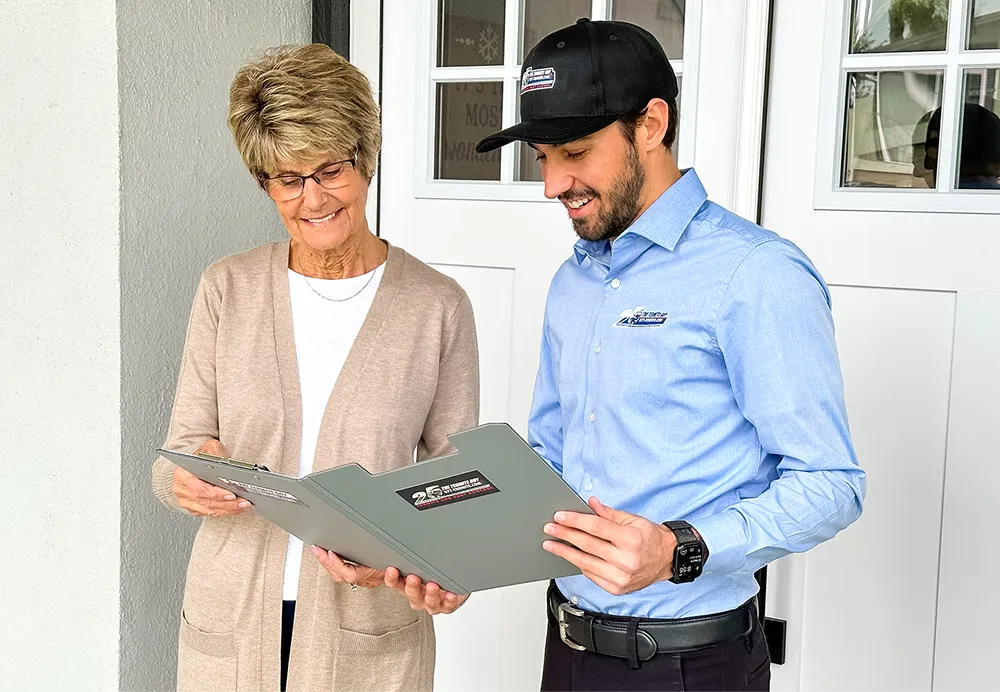
Our technician will call or text ahead, walk the property with you if you're home, and explain findings and next steps in plain language before leaving you with a written report. There's no pressure to decide on treatment on the spot — you'll have the information you need to make the right call for your home.
Warranties typically exclude new damage caused by structural changes made after treatment, conditions an inspector couldn't access, and situations where required follow-up inspections were skipped. Specific terms are spelled out in writing with every warranty we issue.
Yes. Our warranties stay with the property, not the homeowner, so they can be transferred to the new owner when the home is sold. A transferable termite warranty can be a valuable selling point, giving buyers added confidence that the home remains protected.
Our fumigation treatments come with a 5-year warranty against drywood termites, so if the same type of infestation returns to the treated structure within that period, we'll address it under the warranty terms provided in writing at the time of treatment.
Call our office to discuss available payment options for your specific service.
Yes — ask about a free estimate when you schedule with us.
It depends on the treatment type and the extent of the infestation. Fumigation pricing is based on your home's cubic footage (call with your address for a ballpark), while localized treatment pricing depends entirely on what's found during inspection — we don't estimate it sight-unseen.
We've been serving Southern California homeowners and businesses since 1997, as a family-owned and operated company.
Yes — we hold a Structural Pest Control Board license (#PR5121), a Contractors State License Board license covering general building contracting and roofing (B-1 & C-39, #771813), and California Department of Pesticide Regulation Qualified Applicator Licenses.
We do our best to accommodate urgent situations. Call our office for the soonest available appointment.
Yes — we provide termite and pest control services for both residential homes and commercial properties throughout our Southern California service area.
Call our office for the soonest available appointment.
Call us at 877-837-6483 or fill out the contact form on our website, and our team will get you on the schedule.
We're open Monday through Thursday, 7am–5pm, and Friday 7am–4pm. We're closed Saturday and Sunday.
We serve Orange, Los Angeles, Riverside, San Bernardino, and Ventura counties, with offices in Santa Ana and Newbury Park.


Protect Your Home Today
Friday: 7am - 4pm
Saturday - Sunday: CLOSED
Friday: 7am - 4pm
Saturday - Sunday: CLOSED